
There's something we acousticians love: talking in acoustic cues. There are cues for every situation and every calculation...
So, there are a lot of them! Because acoustics is vast!
To provide some clarity, here is a summary of the most commonly used indices for quantifying insulation and absorption in buildings, in the field of acoustics.
Sound, like light, is a composition of frequencies (in Hz) ranging from 20Hz to 20Hz in the audible range.
For insulation performance and the sound absorption, the measures sweep away some frequencies ranging from 50Hz to 5000Hz, a measure every third of an octave.
In this frequency range, there are 21 third octaves, or 21 values to enhance the acoustic performance of materials and systems.
That's a lot!
So it is in a purpose of simplification and comparison between products that the indices exist.
The indices therefore represent a “certain” unique value of the spectrum.
And they're found everywhere, in construction specifications and specifications in the transportation industry. These are clues you need to know to avoid making mistakes during the design phases.
ISO 717-1 and 717-2 standards present methods for calculating acoustic indices for sound insulation and impact noise.
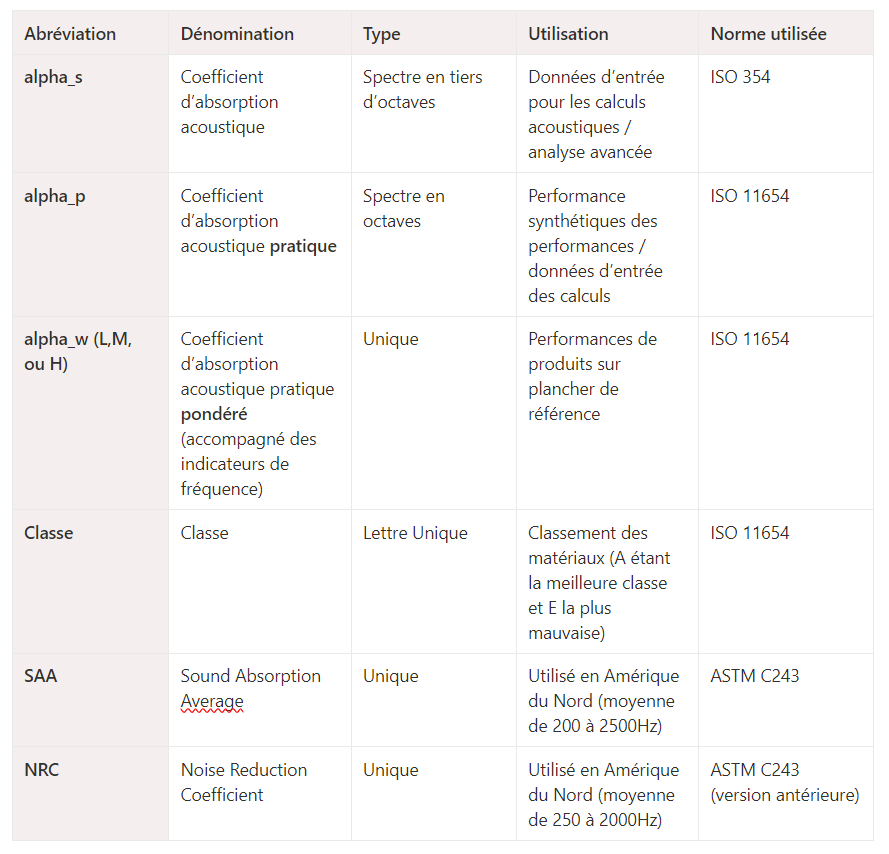
For sound absorption, ISO 11654 allows the calculation of weighted sound absorption ( \ alphaw) as well as the acoustic classes ranging from A to E (A having the best performance).
To calculate these indices from the spectrum, you can use Acouvapp modules
There are two categories of acoustic clues:
Additionally, each type of clue is further divided into two categories:
To make this clear, we will show you the links between lab and in situ clues.
Is that all good? So let's get started...
To establish insulation measurements, the material/system must be positioned between two reverberant rooms.
In one of the rooms, pink noise is generated and the sound insulation is generally the difference in sound level between the two rooms.
Following this measurement, we recover a sound insulation spectrum (often noted R or TL) from which we can calculate the 3 main indices:
The higher these indices, the greater the insulation performance.
Example:
La ISO 717-1 standard specifies use cases for using indices, if no regulation or standard provides any indications:
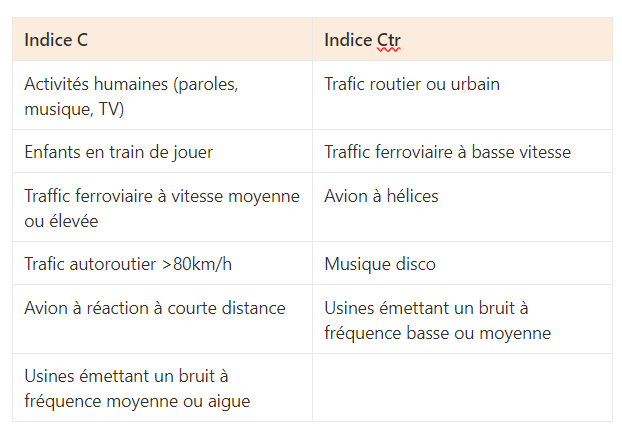
To ensure the article is not unreadable, we will not go into detail about how all these indices are calculated.
However, for information for calculate the Rw:
1. Compare the measurement curve with a reference curve (from the standard)
2. Shift the reference curve until reaching a limit defined in the standard (different if the calculation is carried out in octaves and in thirds of octaves).
The 100-3150Hz range is the most used to calculate these indices.
However, we can find indices taking into account low frequencies (from 50Hz) or higher frequencies (>4000Hz).
When measuring lining, counter partition or ceiling, that is to say when we want to evaluate the insulation contribution, we also present the ΔRw (C,Ctr) with increasingly the denomination “heavy” which is recalculated on a reference support (concrete wall or floor for example). This delta is calculated by taking the difference of the performance with the “dressed” support and the performance with the “bare” support.
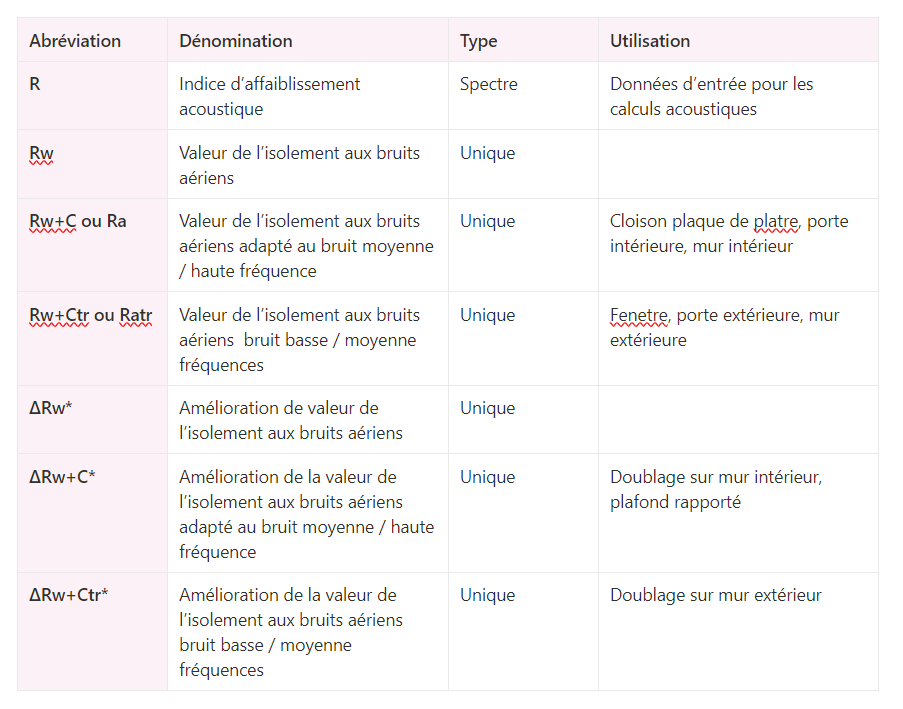
* the “heavy” index is increasingly used, implying that the value is recalculated taking into account a reference wall or floor.
The impact noises are a major focus of the work of building acousticians.
These noises propagate through the structure of a building (floors, walls, ceilings), which makes them very difficult to stop once the building is constructed!
Moreover, the complaints in co-ownership often concern impact noises.
These affect quality of life, sleep, concentration and can be a source of neighborhood conflicts.
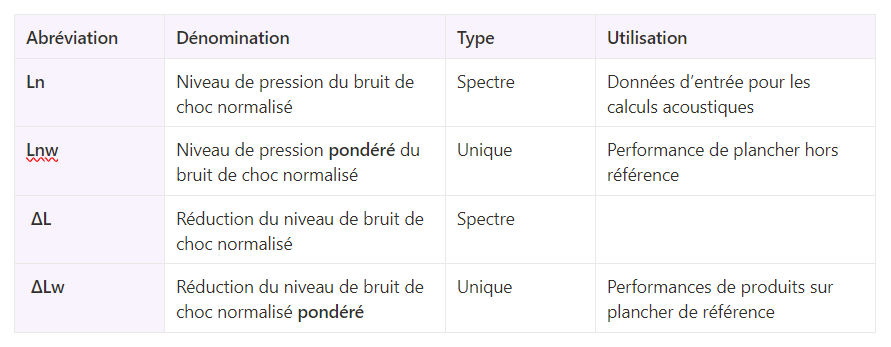
The most used indices are:
The weighted index is calculated from the impact noise spectrum in third octaves noted Ln.
In the same way as for airborne sound insulation, take into account the spectrum from laboratory measurements.
Here's how to take these measurements:
1. a standardized impact machine generates a regular impact on the floor (or system)
2. a measurement of the sound level in the room below is carried out
This measurement is calculated as LnT. The T indicates that the sound level has been standardized with respect to the reverberation time.
So, from the spectrum (Ln) we can calculate the weighted pressure level of the normalized shock noise (Lnw, single value).
The Lnw value is used to obtain the performance of systems that cannot be tested on reference floors (wooden floor, particular concrete floor, etc.)
On the same principle as Rw, the calculation of Lnw is also based on the shift of a reference spectrum compared to the measured spectrum.
Please note, unlike the Rw, the lower the Lnw, the better the performance from product to impact noise.
Moreover, for building products, we often find the ΔLw in dB which is the improvement provided by the product on a reference floor (floor of 140 or 160mm).
Thus, the most typical example is the acoustic underlay under screed with ΔLw values that can range from 19dB to 22dB or more.
Sound absorption is the reduction of the reflection of an incident sound wave on a material.
Absorption is measured in the laboratory according to ISO 354.
1. A material with a surface area of 10-12m² is placed in a reverberation room.
2. Measure the reverberation time with and without the material in the room.
3. Calculate the difference between the 2 reverberation times
It is also possible to determine the absorption coefficient, called alpha sabine (∝s), in thirds of octaves.
Based on the spectrum, the ISO 11654 standard allows several indices to be calculated:
We also find in American standards the SAA and the NRC which are generally averages of certain values of the spectrum (ASTM, etc.).
The main difference between laboratory and in situ measurements is the consideration of lateral transmissions related to other building elements (for insulation and impact noise). However, the principles for calculating single indices are the same as for laboratory measurements and are governed by the same standards.
In-situ the methods for calculating air insulation acoustic indices are identical to those in the laboratory.
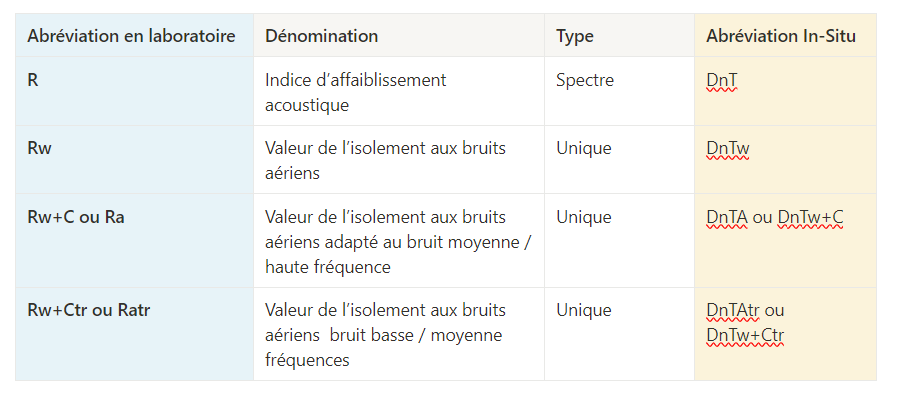
Generally these indices are calculated on the 100-3150Hz range but we can find indices taking into account low frequencies (from 50Hz) or higher frequencies (>4000Hz).
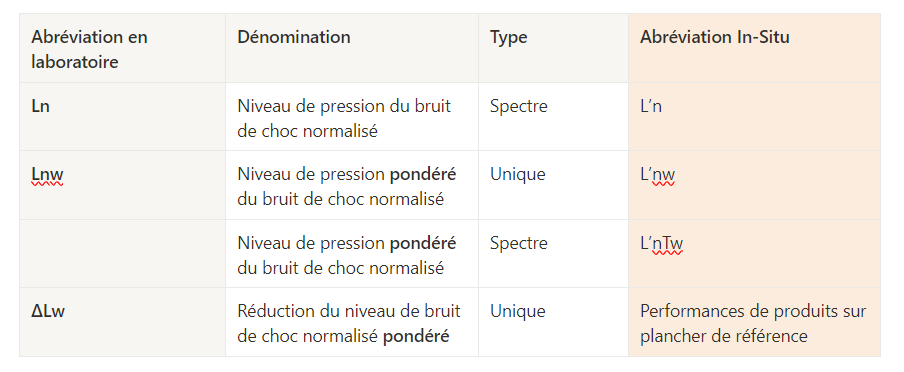
For impact noise, the unique indices of the measurements are quite simple because it is enough to add an apostrophe to specify that it is an in-situ measurement.
In a room, sound absorption is not directly measured.
To qualify it, we measure the reverberation time in seconds (TR). (To learn more about the reverberation time, you can go see in the definitions).
There are no standards for calculating a unique Reverberation time.
However, regulations (or some building standards) specify average reverberation times (average over a few octaves, often 500-1000 and 2000Hz)
Yes, yes, there are still a few of them!
For example, for roller shutter boxes (Dnew) or lateral insulation of continuous ceilings (Dnfw) and even for waterfalls in ducts (LnaT).
But also when taking sound level measurements, whether in a room or environment. This will be the subject of a future article.
The world of acoustics is full of cool acronyms.
As we have seen, there are many unique indices which all have a more or less important utility depending on the application cases.
In these studies, the acoustician will tend to use the spectrum directly, but the unique indices allow for an overview and a rapid comparison of the products between them.
Understanding the meaning of the indices allows you to clearly specify the performance of products in the specifications, the latter often using the unique indices of the materials to justify performance.